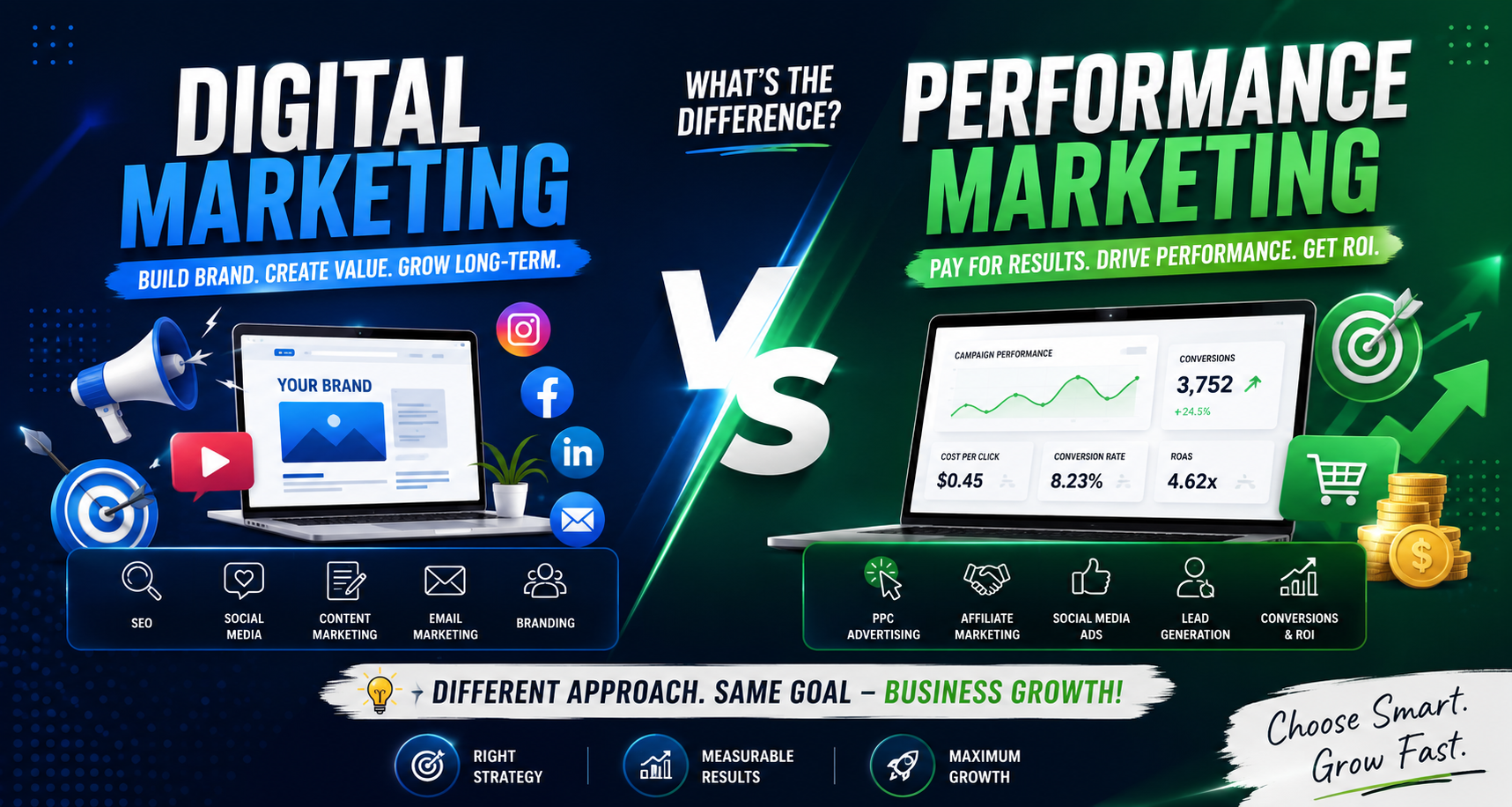
In today’s fast-growing digital world, businesses are investing heavily in online marketing to grow their brand, generate leads, and increase sales. But one question still confuses many business owners and startups — Digital Marketing vs Performance Marketing: What’s the difference?
Both strategies help businesses grow online, but their goals, working methods, and results are completely different. While digital marketing focuses on brand awareness and long-term growth, performance marketing focuses on measurable results like clicks, leads, and sales.
In this complete guide, we’ll explain everything about digital marketing and performance marketing in simple language, including their benefits, differences, strategies, examples, and which one is best for your business in 2026.
What is Digital Marketing?
Digital marketing is a broad term that includes all types of online marketing activities used to promote a business, product, or service through digital platforms.
It helps businesses:
- Build brand awareness
- Reach targeted audiences
- Increase website traffic
- Improve customer engagement
- Grow online presence
Types of Digital Marketing
1. Search Engine Optimization (SEO)
Improving website ranking on search engines like Google.
2. Social Media Marketing
Promoting brands on Instagram, Facebook, LinkedIn, and other platforms.
3. Content Marketing
Creating blogs, videos, and valuable content to attract customers.
4. Email Marketing
Sending promotional emails and newsletters to customers.
5. Influencer Marketing
Collaborating with influencers to promote products or services.
6. Video Marketing
Using video content for audience engagement and branding.
What is Performance Marketing?
Performance marketing is a results-driven marketing strategy where businesses pay only when a specific action happens, such as:
- Clicks
- Leads
- App installs
- Purchases
- Conversions
This marketing method focuses mainly on measurable ROI (Return on Investment).
Common Types of Performance Marketing
1. Pay-Per-Click (PPC) Advertising
Businesses pay when users click on ads.
2. Affiliate Marketing
Affiliates earn commission for generating sales.
3. Social Media Ads
Running targeted paid campaigns on Meta, Instagram, LinkedIn, etc.
4. Native Advertising
Ads designed to match platform content naturally.
5. Conversion Marketing
Campaigns optimized specifically for sales and leads.
Digital Marketing vs Performance Marketing: Key Differences
| Feature | Digital Marketing | Performance Marketing |
|---|---|---|
| Goal | Brand Awareness | Sales & Conversions |
| Focus | Long-Term Growth | Immediate Results |
| Payment | Fixed Budget | Pay for Results |
| Metrics | Traffic, Reach, Engagement | Leads, Sales, ROI |
| Strategy | Organic + Paid | Mostly Paid Ads |
| Best For | Branding | Lead Generation |
| Timeframe | Long-Term | Short-Term |
Best Strategy: Use Both Together
Successful businesses combine both strategies.
For example:
- Use SEO and content marketing for long-term growth
- Use paid ads for quick lead generation
This creates a balanced marketing strategy that delivers both branding and revenue.
Companies like Google Ads and Meta Ads Manager are widely used for performance marketing campaigns, while platforms like HubSpot support broader digital marketing strategies.
Final Conclusion
Digital marketing and performance marketing are both essential for modern businesses. Digital marketing helps create brand identity and long-term online presence, while performance marketing focuses on quick, measurable business results.
Instead of choosing one over the other, businesses should combine both strategies to maximize growth, leads, and ROI in 2026.
If your goal is sustainable business growth, customer trust, and consistent lead generation, integrating digital marketing with performance marketing is the smartest approach.
FAQ's
Is performance marketing part of digital marketing?
Yes, performance marketing is a subset of digital marketing focused on measurable results.
Which is more effective: SEO or performance marketing?
SEO is better for long-term growth, while performance marketing gives faster results.
Is performance marketing expensive?
It depends on your advertising budget and campaign goals.
Can small businesses use performance marketing?
Yes, even small businesses can generate leads using targeted ads.
Which is best for startups?
Startups should combine SEO, social media marketing, and paid advertising for better growth.

Leave a comment
Your email address will not be published. Email is optional. Required fields are marked *